




Home
Ningbo Intellectual Property Rights College inaugurated
The Ningbo Intellectual Property Rights College was inaugurated at Zhejiang Wanli University on the afternoon of April 24. By fostering the "science + law" inter-disciplinary talents, the college aims to enhance the work of intellectual property rights creation, application, management and protection, promote the transfer and transformation of the scientific and technological achievements, and provide services for the innovation-driven development of Ningbo and even Zhejiang Province.
As is known, the application and operation of high-value patents usually involve some specialized issues in science and engineering. With the improvement of the enterprises' awareness of intellectual property rights, the talents with a law major only can not meet the demands of the related positions.
To address the problem, Ningbo has decided to establish this college on intellectual property rights, with the scheme of "2+2" model for compound talents cultivation. "We will select some students from the distinguished sophomores majoring in science or engineering, and cultivate them as inter-disciplinary talents with strong legal and technological background." said Sheng Gang, Dean of the Law School of Zhejiang Wanli University. To meet the city's industrial needs, the new college will develop a series of featured courses in such emerging fields of intellectual property rights as new-generation information technology, new materials and bio-medicine.
Reportedly, the college will enroll its first 30 students this September from such sciences or engineering colleges as computer science, architecture and design, and biology and environment. In addition, the college students will have chance to have a six-month internship in enterprises or law firms in Ningbo, thus shortening the graduates' adjustment period for work
- Details
- Category: On The Campus
First CLC institute of lifelong learning established in Ningbo
The first lifelong learning institute for rural community learning center (CLC) in China was announced to settle down in Ningbo at the seminar on rural adult education & "Belt and Road" construction, as well as the agreement-signing ceremony of the institute. Approved by the Representative Office of UNESCO in China and China National Commission for UNESCO, the institute is the extension and development of the "construction of rural community learning center" implemented in Asian and Pacific countries since 1998 by the UNESCO.
As is reported, the institute is jointly built by Ningbo Education Bureau and Chinese Adult Education Association, and will be coordinated and management by Ningbo Adult Education College. According to the agreement, based on their related resources, the co-builders of the institute will introduce the advanced concepts for rural education in the world,
- Details
- Category: On The Campus
Read more: First CLC institute of lifelong learning established in Ningbo
9 Top Universities to Tap Technology Market in Ningbo
Recently, officials from 9 top universities--Harbin Institute of Technology (HIT), Northwestern Polytechnical University and Beijing Institute of Technology--gathered at HIT’s incubation base at Ningbo to exchange views on establishing a coordinated innovation platform. Experts discussed about how to develop a private technology market that radiates to the Yangtze River Delta in Ningbo, thereby achieving the commercialization of research outcomes.
The nine institutions of higher education are directly subordinate to Ministry of Industry and Information Technology of the PRC and Ministry of Education of the PRC, including other six members as Chongqing University, Dalian University of Technology, Southeast University, South China University of Technology, Tianjin University and Tongji University.
- Details
- Category: On The Campus
Read more: 9 Top Universities to Tap Technology Market in Ningbo
The young and the cautious
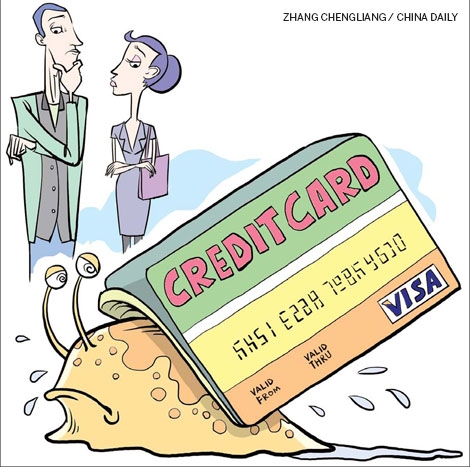
The world, teetering on the edge of another financial crisis, needs Chinese consumers to save less and spend more. Chinese consumers need to increase domestic demand so the country can reduce its heavy reliance on exports to keep fueling economic growth.
But Chinese consumers aren't playing ball. They are diligently saving money and cautious when it comes to spending money, evident by the country's consumption-to-GDP ratio of 36 percent - only half that of the United States and about two-thirds the figure for Europe.
Bank executives are optimistic that credit cards will be the answer to encouraging Chinese consumers to spend, just as they have on consumers elsewhere.
With about 230 million credit cards issued by 2010, bank executives are salivating at the prospect of tens of millions more consumers adding credit cards to their wallets.
With more than 2.1 billion debit cards in circulation for a population of about 1.3 billion, it is only natural to assume Chinese consumers have a voracious appetite for plastic and would therefore be as enthusiastic about credit cards. This expected exponential demand for credit cards hasn't happened.
Credit cards haven't proved to be particularly profitable so far. Profitability per card, according to the Lafferty Group, is thought to be roughly $1 per year.
New research conducted on young, affluent credit cardholders at a private university in China sheds light on why the picture is unlikely to improve dramatically for credit card companies any time soon.
The research, a joint project involving Australia's Monash University and The University of Nottingham Ningbo China, also suggests that we should not rely on consumer credit to structurally change how Chinese spend money, and, by implication, the world economy in the short term.
Credit cards, blamed for many a household's financial woes in the United States and Europe, are relatively new to China. They were only permitted beginning in the mid-1990s, resulting in structural impediments to the development of China's consumer finance industry.
It is well-known that the idea of saving is deeply entrenched in the Chinese culture. It is estimated that the average Chinese family saves 25 percent of its discretionary income - six times the savings rate for US households and three times the rate for Japanese.
Not common knowledge, however, is that youths are just as thrifty savers as the elderly. Urban households headed by 25-year-olds are believed to save about 30 percent of their disposable income. Households with sons are the main accumulators of assets, especially property.
We investigated the attitudes of young, affluent Chinese toward credit cards in order to determine whether they will become popular among this important group of consumers. It is, after all, among young people where major shifts in behavior tend to occur and how new consumer spending trends develop.
We chose The University of Nottingham's Ningbo, China, campus because it is located in Zhejiang, which is one of the most developed provinces in China, with high levels of income per capita and therefore a large potential for credit card usage.
University students make an ideal sample for a credit card study because they represent a section of the population who are quite different from their parents' and grandparents' generations in terms of their consumption behavior.
They are, in short, more likely to hold a credit card.
We canvassed the views of more than 150 students, screening them first to ensure that they were credit card holders. The majority of the students sampled received a generous allowance from their parents, which meant there wasn't a financial constraint on potential credit card usage.
In the case of undergraduates, the average annual allowance of 20,000 yuan (2,170 euros) is almost twice as high as the average annual income of a Chinese worker. Postgraduates typically receive about 45,000 yuan a year.
Most undergraduates, 71 percent, held a single credit card, while 75 percent of postgraduates owned more than one card and as many as three.
However, holding multiple credit cards did not result in greater usage. More than half of the students used their cards only once a month, with nearly one-third only using their credit cards once or twice a year.
The main reason given for the limited usage was the lack of a payment terminal infrastructure, even in modern second-tier cities such as Ningbo.
One student said: "Unfortunately, we cannot use our cards wherever we want. Small shops don't have payment terminals so we cannot use them as often as we would like."
The second most common reason for not using a credit card was the terms of the payment method.
Another explained her card was issued in her hometown. "When I want to pay it back I need to go there to give the money to the bank. I cannot do it here so I don't think it is convenient."
Clearly the banks and the authorities need to get together to find more ways to accept credit cards and re-think the awkward repayment method. Currently, it's not easy to use and manage a credit card in China, even if you wanted to shop until you drop.
There is another obstacle in the way of the credit card market developing, and it is potentially much harder to resolve because it involves deep-seated attitudes toward money.
Young, affluent consumers are very astute about the risks involved in using credit cards. And they are very aware of the costs associated with borrowing money.
Cardholders interviewed in focus groups told us that they believe it's more convenient to pay with a card than cash, and that they believe carrying cash can be unsafe.
However, these positive associations of credit cards were tempered by the concerns of the loss of financial control.
At least two-thirds of all of the students interviewed believed that paying by credit card encourages people to spend beyond their means, even if they use the card infrequently. And, they have tremendous feelings of guilt associated with using a credit card or racking up debt.
Several students made comments similar to this: "I don't like using future money to pay for today. I did not make any money today and I still used money (to purchase products) when I use my credit card . ... I feel guilty for that."
So, clearly, it is not just the convenience of the service provided that influences card usage, but there is also an underlying fear of overspending and a loss of financial control.
The good news for credit card companies is that the lure of promotions sometimes outweighs the risk aversion.
This, our analysis suggests, is particularly the case for promotions that advertise discounts and additional free products because they tap into the cultural perceived necessity to both save and yet simultaneously accumulate products to show wealth to others.
Signaling wealth is very important, though it is still best done in China by flashing cash around.
As one respondent in our study observed, "Cash is still king . A businessman with a lot of cash in his wallet shows that he is affluent."
Reminding the young and the affluent that they are part of a new generation is also important in getting buy-in. Students spoke about credit cards making them "feel cool" and as objects to emphasize that they are different, and perhaps more sophisticated, than their parents.
But overall, marketers have a tough job on their hands trying to convince China's Little Emperors to churn up debt using revolving credit. They still retain many of the conservative cultural attitudes of their parents when it comes to debt.
They are also keenly aware of the high costs of using a credit card to make cash advances. Unlike their peers in the West, young Chinese consumers do not have a laissez-faire attitude to money and long-term savings goals.
The implications for the West are we shouldn't count on credit cards to get the tills ringing in China to help stimulate developed economies.
Bank executives, meanwhile, should consider other financial offerings for the enormous, but fairly elusive, young customer base in China.
The author is an assistant professor of marketing at the Nottingham University Business School China. Her full research report on credit cards in a Chinese cultural context, with professor Steve Worthington and David Stewart of Monash University's department of marketing, is in the latest Journal of Retailing and Consumer Services. The opinions expressed in the article do not necessarily reflect those of China Daily.
- Details
- Category: On The Campus
Page 1368 of 1699