




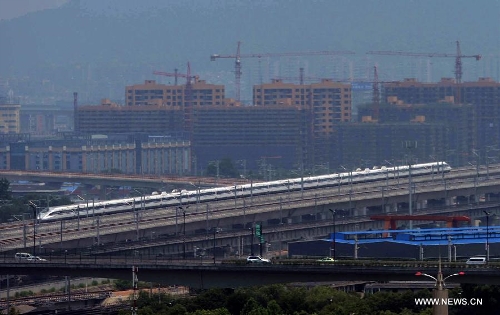
A high-speed train moves on the Nanjing-Hangzhou high-speed railway, east China's Zhejiang Province, May 24, 2013. High-speed rail lines from Nanjing to Hangzhou and Hangzhou to Ningbo began a month-long trial operations on Friday. (Xinhua/Han Chuanhao)
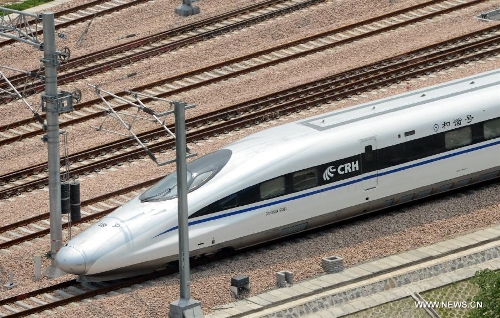
A high-speed train leaves the Hangzhou East Station for Nanjing in Hangzhou, capital of east China's Zhejiang Province, May 24, 2013. High-speed rail lines from Nanjing to Hangzhou and Hangzhou to Ningbo began a month-long trial operations on Friday. (Xinhua/Han Chuanhao)
- Details
- Category: Governmental News
Read more: Nanjing-Hangzhou-Ningbo high-speed rail lines begin trial operations
Home
More foreigners coming to live in China
CHINA is growing into an increasingly attractive migrant destination, with the number of immigrants soaring by 35 percent during the first decade of the 21st century.
That’s according to the 2013 World Migration Report, released and translated a week ago by the Center for China and Globalization, an independent, non-profit think tank based in Beijing.
“But compared with China’s high-speed development, it’s still not enough,” the organization’s director-general, Wang Huiyao, told the Mirror, a Beijing-based legal newspaper. “Just because many Chinese elites are going abroad, we are desperate for more talents to come in.”
The report also reveals a new trend that more people are moving from high-income countries to low-income nations in recent years, although the numbers are still relatively small, comprising 3-6 percent of global migration.
According to the report, China had 685,775 immigrants at the end of 2010, 35 percent more than that at the beginning of 2000. “Undoubtedly China is becoming a very appealing migrant destination,” Wang said.
Andereas Kohl, 38, has been working as an engineer in a car company in Shanghai for about six years. The German cites China’s dynamics and fast development as the biggest reason for settling down in China.
“China’s automobile industry is in its prime and it needs people like us. For me, I can easily find a job and do what I’m good at here,” Kohl said.
The World Migration Report indicates that economic opportunity is the biggest motivation for the global migration flow from developed to underdeveloped regions. It points out that northern countries are faced with financial crisis, while the southern countries have emerging new economies that are in need of technical talents.
China magnet for migrants
Due to rapid development and demographic changes, China is a lure for migrants. Labor shortages result in rising wages and more demand for foreign workers.
In addition, China is becoming headquarters for numerous international companies and institutions, and the expansion of multinational companies induces overseas Chinese to return to the country.
Statistics show that in 2011, the number of returned overseas students exceeded those who studied abroad for the first time — by 50 percent.
Having lived in Suzhou, Jiangsu Province, for almost four years and married to a Chinese woman with two kids, Professor Jean-Francois Vergnaud has made the city his second home. “I love the country and the city. It’s my home now,” he said.
However, there is one thing that upsets the Frenchman. He is anxious to get a green card — permanent residence in China for foreigners. For now, he can only wait. Meanwhile, Vergnaud has to extend his work visa every year, a major inconvenience.
China’s green card, many expats joke, is the world’s hardest card to get. According to the Management of Permanent Residence in China for Foreigners, launched in 2004, one condition for a green card is that a foreigner must marry a Chinese spouse for at least five years and stay in China for at least nine months every year with a stable income and a place to live.
The green card system was implemented in 2004, and only about 4,700 cards were issued by the end of 2011, on average of just 248 a year. In contrast, more than 600,000 foreigners had settled down in the country at that time.
David Mok of Canada has been living in Shanghai for about six years. He has bought a flat and married a Shanghai woman, but he is still applying for his green card. “It feels like the country doesn’t welcome us very much,” he said with a bitter smile.
The latest statistics reveal that there are more than 800,000 foreign migrants in China, while the number of Chinese settling down overseas has reached almost 10 million. Wang called this phenomena “migrant deficit.”
Most Chinese going abroad are from the country’s elite and wealthy class, while migrants moving in are often from developing countries and regions, according to an agency specializing in immigration business in Beijing.
The migrant deficit and difference, Wang said, is due in part to China’s work permit, visa, green card and the nationality system not yet being open.
“Talents need to flow. China has not set up a complete migration system to cope with the global competition of human resources,” said Liu Guofu, a law professor at Beijing Institute of Technology.
“China has opened its door for various global economies, and it’s time for the country to open to the talents from the world,” Wang said. “People going out, we need more coming in.”
He pointed out that in the future, China should create an internship work visa for foreign students, improve the green card issue rate, lower the threshold for green card applications and launch a China citizenship path for foreigners.
“Each country wants to attract talents and reject those who cannot make contribution. So it’s urgent for China to perfect migrant laws and regulations,” Liu said.
By Tan Weiyun | May 31, 2014, Saturday ShanghaiDaily
- Details
- Category: Governmental News
Multi-functional Platform in the Financial Sector Put on Trials
According to Jiangdong branch of Ministry of Public Security, the multi-functional platform in the financial sector has been recently put on trials after about half a year’s painstaking studies. The latest development has come after the first ever financial security big data research base was settled in Jiangdong district in August 2015. The platform is essential to sound development of the economy. The pilot program will be replicated steadily if it turns out to be a viable one.
Home to whopping 403 financial enterprises, Jiangdong district is made vulnerable to finance-related crimes. As part of the effort to keep the district economy strong and growing, the public security watchdog has offered to put in place a financial security information service center, thereby ratcheting up efforts to pre-warn, forestall and battle against financial crimes. As of now, the center has issued 26 pre-warning reports to the government, financial regulators and institutions and dealt with 180 related cases.
The innovative initiative was appreciated by Big Date Laboratory of MPS amidst exchanges during the first summit of Internet Financing Security Forum. After rounds of consultations, the first ever Financial Security Big Data Research Base was settled in Jiangdong. The base is dedicated to building up capabilities on multiple fronts by leveraging big data. Such capabilities span background check, risk assessment, analysis and predictions, pre-warning issuance, practical applications. This will help put in place a regional financial risk pre-warning system and financial crime combating mechanism. Thanks to half a year’s efforts, breakthroughs have been made in the platform, which will be extended down the road.
- Details
- Category: Governmental News
Municipal Health and Family Planning Commission Arranging the Work to Prevent Diseases
Due to the strike of Typhoon Dujuan, torrential rain has hit Ningbo since September 29, causing dangerous inland inundation. Ningbo Municipal Health and Family Planning Commission summoned an emergency meeting to arrange the work on keeping good sanitation and hygiene conditions to prevent diseases. There are four specific items put forward at the meeting.
Firstly, focus should be put on killing bacterium after the disaster. In line with the idea that the sterilizing work should be conducted instantly where the flood subsides, the environment should be cleaned up and disinfected in time to prevent from breaking infectious diseases after the inland flooding.
Secondly, the monitoring of epidemic diseases needs to be enhanced. We should endeavor to prevent and control acute infectious intestinal diseases, arthropod-borne epidemic diseases or others transmitted between human beings and animals. Medical institutions must open separated diagnosis channels for intestinal health and fevers, and organize the monitoring work of fever and diarrhea. Centers of disease prevention and control at all levels should strengthen the monitoring and analysis of after-disaster infectious diseases and breaking-out of public health emergencies, and also carry out the risk assessment of those illness.
Thirdly, drinking water security must be guaranteed. Health supervision institutes should monitor the quality of the source and treated water in the water factory and also the tap water. For those supply units found with disqualified water, they must take corrective measures to ensure secure drinking water. Besides, hygiene supervision should be stressed in those makeshift settlements to put sterilizing, ventilation, and drinking water cleaning up and other relevant measures into practice to prevent diseases.
Currently, the municipal center for disease control and prevention has established 3 emergency teams and 11 detachments to be sent for districts to supervise and guide the disease prevention after the disaster. The center has also prepared 20.62 tons of beaching powder and bleaching powder concentrate, and 15 boxes of effervescent tablets for sterilization. Meanwhile, the center has released notices of disease prevention through the portal site, micro-blogging and we-chat, etc., which has also printed over 1,000 posters and 50,000 folders for publicizing disease prevention after the flood disaster
- Details
- Category: Governmental News
Nanjing-Hangzhou-Ningbo high-speed rail lines begin trial operations
HANGZHOU - A new high-speed railway that stretches across East China's Yangtze River Delta began trials on Friday, according to local railway authorities.
The Nanjing-Hangzhou-Ningbo high-speed railway, with a designated top speed of 350 km per hour, will cut travel time between Nanjing, capital of East China's Jiangsu province, and the port city of Ningbo in East China's Zhejiang province to about two hours, sources with the Shanghai Railway Bureau said.
High-speed trains will run at a speed of 300 km per hour during the trial operation period, which will last one month.
The railway is scheduled to go into commercial service at the end of June, according to the bureau.
The high-speed railway is expected to boost the region's economy and foster the growth of tourism in the three cities it links.
Page 1238 of 1699